Home » VEGETATION IN THE MOUNT NYIRAGONGO AREA
VEGETATION IN THE MOUNT NYIRAGONGO AREA
Get to know the wild range of plant life around or vegetation in the Mount Nyiragongo area in Virunga National Park — from steamy tropical rainforests to hardy Afro-alpine plants.
You’ll see unique species, spot wildlife, and figure out the best ways to experience this volcanic landscape on a Congo safari.
Mount Nyiragongo sits in Virunga National Park in eastern Democratic Republic of Congo. It’s one of Africa’s most active volcanoes, reaching 3,470 meters (11,385 feet).
The mountain towers over Virunga, a UNESCO World Heritage Site famous for its biodiversity and rare ecosystems.
It’s best known for holding the world’s largest permanent lava lake, but its rich natural surroundings are just as striking.
The plant life here shifts dramatically as you climb. Different altitude zones support everything from mountain gorillas to rare birds and other primates.
Whether you’re hiking the volcano, trekking for gorillas, or out birdwatching, Nyiragongo’s vegetation is a highlight on its own.
For eco-tourists, botanists, and anyone chasing adventure, this is one of the most scenic and biodiverse corners of Africa.
Virunga National Park – Home of Mount Nyiragongo
Virunga is Africa’s oldest national park and a UNESCO World Heritage Site. It covers 7,800 km² of volcanoes, savannahs, swamps, and even glaciers.
More than 3,000 plant species grow here, and many are rare or found nowhere else. The park is also home to dozens of mammal species and hundreds of birds.
Mount Nyiragongo sits in the park’s Virunga Mountains. It’s famous for eruptions, and that massive lava lake, but its fertile volcanic soils and shifting climates create distinct plant zones that change with altitude.
That’s what makes the vegetation here so rich and varied.
Types Of Vegetation in the Mount Nyiragongo Area
1. Tropical Rainforest
The lower slopes are wrapped in dense tropical rainforest. It’s warm, humid, and thick with towering trees, tangled vines, and a forest floor covered in ferns and moss. This zone is packed with life:
- Primates like Colobus monkeys moving through the canopy
- Bright butterflies and countless insects
- A huge variety of birds
- Medicinal plants that local communities still use
2. Bamboo Forests
Between 2,800 and 3,200 meters (9,200–10,500 feet), the rainforest gives way to bamboo. These hardy stands handle the cooler, wetter conditions up here.
The bamboo zones matter because:
- They’re a main feeding ground for mountain gorillas and other small mammals
- They shelter rare bird species
- They thrive in the cool, moist mountain air
3. Montane Forests
Above the bamboo belt and below the alpine zone, montane forests take over. It’s cooler, wetter, and the trees and shrubs are often draped in moss.
You’ll see a mix of evergreen and deciduous species, with thick undergrowth that hides plenty of birds and small primates.
This zone is home to:
- Tree hyraxes
- Forest antelopes
- Endemic birds like the Rwenzori turaco
4. Afro-Alpine/Subalpine Vegetation
Above 3,000 meters (9,800 feet), things get tough — cold nights, strong sun, and biting winds.
The plants here are Afro-alpine specialists, like giant groundsels (Senecio adnivalis) and giant lobelias (Lobelia wollastonii).
They’ve adapted with water-storing tissues and leaf rosettes that act like insulation, letting them survive wild temperature swings.
Come to Congo’s Virunga National Park and walk through the Nyiragongo area to see all of this yourself.
Popular Plant Species Found in The Nyiragongo Vegetation Cover
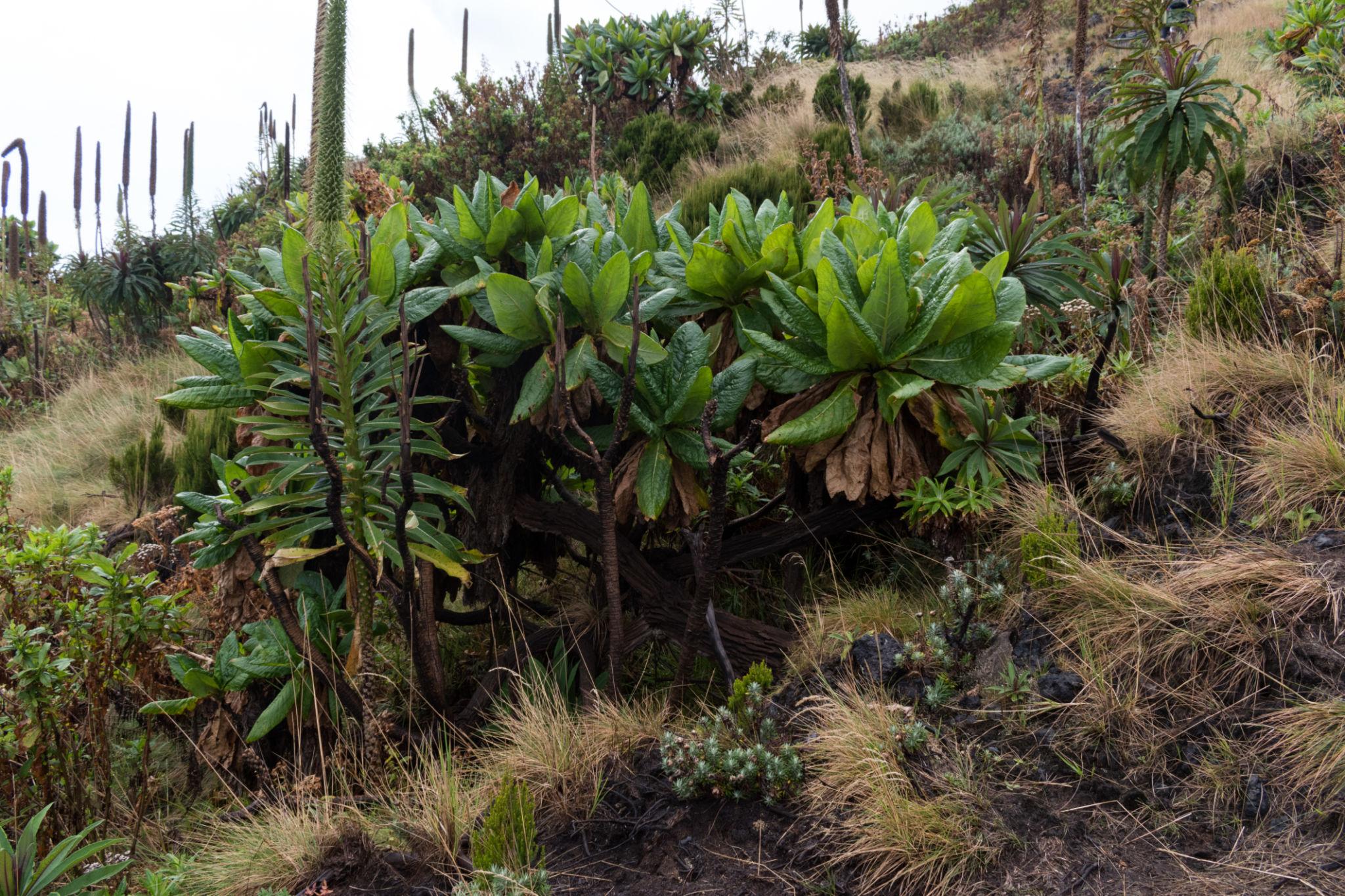
Keep an eye out for:
- African mahogany (Khaya anthotheca) – common in the lower rainforest
- Tree ferns – love the damp understory
- Various bamboo species – a key food for mountain gorillas
- Mosses and lichens – they’re the first to colonize fresh lava fields
- Giant groundsels and lobelias – the iconic alpine plants
- Wild banana plants
Factors Influencing Vegetation Growth in the Nyiragongo Area
- Climate: As you climb, temperatures drop and rainfall patterns change. That’s what creates the distinct plant zones.
- Geology: Mineral-rich volcanic soils feed lush growth. But fresh lava flows stay bare for years until pioneer plants move in.
- Volcanic Activity: Eruptions have reshaped the landscape for centuries. After lava cools, mosses, lichens, grasses, and shrubs slowly take back the ground.
- Human Activity: Farming, charcoal burning, and grazing near the park edges have cleared some lower forest.
Virunga’s rangers are working to protect what’s left and restore damaged areas.
Outstanding Tourist Attractions Seen in the Nyiragongo Area Vegetation
Walking through Nyiragongo’s plant zones puts you right in the middle of some amazing wildlife and scenery during DR Congo tours or Congo hiking safaris:
Mountain Gorillas
In the bamboo and montane forests, you might come face-to-face with Virunga’s famous mountain gorillas. They depend on local plants — especially bamboo shoots and wild banana pith — for food. Trekking through these zones is one of the top reasons people book Congo gorilla safaris.
Other Primates
Golden monkeys, blue monkeys, L’Hoest’s monkeys, and colobus monkeys all live in the forest canopy here.
Other Wildlife Species
The vegetation shelters duikers, bushbucks, and small carnivores you might spot on a Virunga wildlife safari.
A Diverse Array of Bird Species
Virunga has over 700 bird species. Many are forest specialists or migrants that use the Nyiragongo plant cover, like the Congo Peafowl, Cassin’s Hawk-Eagle, and Kivu Ground Thrush. Birding tours here are incredible.
Reptiles
The warm, humid lower slopes are home to chameleons, snakes, and geckos worth looking for on a Congo safari.
OTHER ATTRACTIONS SEEN ON MOUNT NYIRAGONGO
- The world’s largest lava lake
- Sweeping viewpoints of other Virunga volcanoes
- Dramatic climbing routes up Nyiragongo
- Volcanic features: ash fields, cinder cones, fumaroles, lava benches
- The crater rim and caldera floor
Book a Congo tour to Virunga National Park and see all of this in person.
How Best to See the Vegetation and Flora in the Mount Nyiragongo Area?
To really experience Nyiragongo’s plant life, try these activities:
Hiking Mount Nyiragongo
A guided trek from the rainforest at the base all the way to the Afro-alpine summit takes you through every vegetation zone.
The hike starts at Kibati Ranger Post and takes 5–6 hours over rainforest trails, old lava fields, and rocky ground. You’ll stay in summit huts with views of the lava lake, day and night.
Mountain Gorilla Trekking
Track gorilla families in Virunga’s bamboo and montane forests near Nyiragongo or in the nearby Mikeno sector. It’s a close-up look at the gorillas and the plants they depend on.
Birdwatching
From dense forest canopies to high alpine zones, birding around Nyiragongo shows off both rare birds and stunning plant landscapes. Bring binoculars for endemic and migratory species.
OTHER ACTIVITIES FOR GLIMPSES OF NYIRAGONGO’S VEGETATION
Nature walks, mountain biking, volcano boarding on cooled lava, and photography tours are all great ways to explore. Pick any of these for memorable views of Nyiragongo’s plant cover.
Threats to the Vegetation and Flora in the Nyiragongo Area
- Deforestation from farming and charcoal production
- Climate change shifting rain and temperature patterns
- Volcanic eruptions wiping out mature plant zones
- Poaching that indirectly damages habitats
Importance Of the Nyiragongo Area Vegetation and Why It Needs to Be Preserved
Nyiragongo’s plants:
- Provide critical habitat for endangered wildlife, including mountain gorillas
- Prevent soil erosion on steep volcanic slopes
- Store carbon and help regulate the climate
- Support eco-tourism and local livelihoods — people make crafts from plants here
Ongoing Monitoring and Conservation Efforts to Preserve the Vegetation in The Nyiragongo Area
- Virunga rangers and NGOs are actively protecting the area through:
- Ranger patrols to stop illegal logging
- Reforesting damaged zones
- Helping local communities find eco-friendly ways to earn a living, so there’s less pressure on the forest.
- Scientific monitoring of how vegetation recovers after eruptions
Guidelines for Exploring the Nyiragongo Area Vegetation
- Always go with an official park guide
- Stick to marked trails
- Don’t pick plants or disturb wildlife
- Dress for fast-changing weather
- Wear proper hiking gear
- Follow all park rules to protect the vegetation
Where To Stay When Visiting the Nyiragongo Area?
- Mikeno Lodge – luxury safari lodge
- Nyiragongo Summit Shelters – basic, right at the top
- Kibumba Tented Camp – midrange with volcano views
- Budget guesthouses in Goma – for affordable stays
Booking And Safari Prices Incurred on Nyiragongo Safaris to See Its Flora and Vegetation
Expect these typical costs: park entry ($35–$50), Nyiragongo hiking permit ($300), optional gorilla trekking permit ($400), guide fees ($20–$30), accommodation ($50–$250 per night), and transport ($100–$200).
Work with trusted Congo tour operators like Prime Safaris and Tours Ltd, Congo Gorilla Safaris and Tours, Wild Gorilla Safaris, and Africa Safaris Tours, to plan your trip.
How To Get to The Nyiragongo Area to See the Vegetation?
Most travelers fly into Kigali, Rwanda, then drive to Goma via the Gisenyi border. You can also fly directly to Goma International Airport. From Goma, it’s about a 30-minute drive to the Kibati Ranger Post. Tour companies usually handle transport, border crossings, and visa help.
Best Time to Visit the Nyiragongo Area to See the Flora and Vegetation
Go during the dry seasons — June to September and December to February. Trails are less muddy, views are clearer, and hiking is more comfortable.
What to Pack and wear for Nyiragongo Area Trips in the democratic republic of Congo?
- Sturdy hiking boots
- Warm layers for high altitude and cold summit nights
- Binoculars and a camera
- Reusable water bottle
- Rain jacket
- Proper hiking gear
- Walking stick
- Headlamp
Check with your Congo travel agent for a full packing list so you don’t overpack.
Vegetation Around Mount Nyiragongo: Common Questions
- What kind of volcano is Mount Nyiragongo?
It’s a stratovolcano, and it’s famous for its lava lake — the biggest permanent one on earth. It’s also one of the most active volcanoes in Africa, and a highlight of any DR Congo trip.
- Where is Mount Nyiragongo?
You’ll find it in the Virunga Mountains, inside Virunga National Park in North Kivu Province, eastern DR Congo.
- Is Mount Nyiragongo still active?
Very. It’s one of the most active volcanoes anywhere, with runny, fast-moving lava and a lava lake that never stops bubbling.
- How did Mount Nyiragongo form?
It came from the East African Rift Valley. As tectonic plates pulled apart, the Virunga range rose up, and Nyiragongo took shape as a steep-sided stratovolcano.
- Is it safe to hike Mount Nyiragongo?
Yes, as long as you go with Virunga National Park rangers. The Goma Volcano Observatory keeps an eye on activity and sends out alerts. Just follow the rules and stay in the official shelters.
- How long does the Nyiragongo hike take?
Plan on 5 to 6 hours to reach the top. You’ll stop for water, rest, and to adjust to the altitude. Parts of the trail are steep and rocky.
- What kind of plants grow on Mount Nyiragongo?
It changes with height. You start in thick rainforest at the base, move through bamboo and montane forest, and finish in Afro-alpine plants near the summit. The slopes are full of life — Afro-alpine meadows, bamboo stands, Hagenia woodlands, and ferns pushing up through old lava.
All of that shelters rare gorillas and plants you won’t see anywhere else. It’s a raw, volcanic landscape that’s worth trekking.
Thinking about an eco-safari? Get in touch with expert local guides and see Nyiragongo’s wild, living landscape for yourself.
Want to visit Kahuzi-Biega?
Kahuzi-Biega National Park, is a secure area close to Bukavu town in Eastern Democratic Republic of Congo.
