Home » Travel Blog » GORILLA FACTS, FACTS ON GORILLAS, FACTS ABOUT GORILLAS
GORILLA FACTS, FACTS ON GORILLAS, FACTS ABOUT GORILLAS
Are you curious about the Gorilla wildlife species? Gorilla facts stated below will cure this curiosity and give you a fresh view of what these species are all about!
One of the strongest and most amazing animals on the planet is the gorilla. Gorillas, the largest of the apes, are one of our closest relatives because we share roughly 98% of our DNA with them.
The forests of Central and Equatorial Africa are home to these gentle giants, which are essential to the ecosystems in which they live.
These gorilla facts below will astound you, regardless of whether you’re organizing a once-in-a-lifetime gorilla trek in Africa or you simply enjoy learning about wildlife.
Facts On Gorilla Species Existing in The World
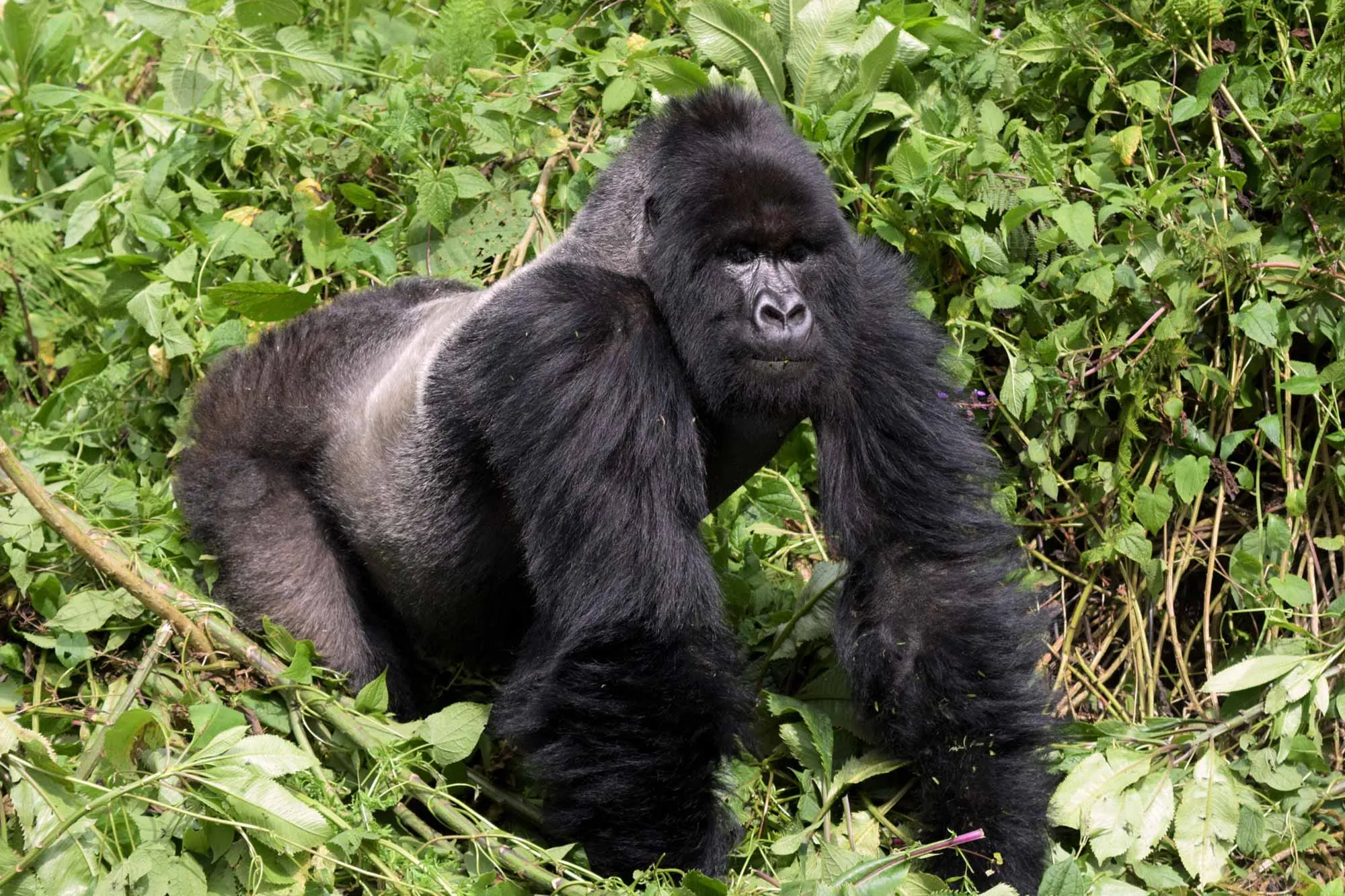
Gorillas are the largest great apes, classified under the genus of Gorilla, family Hominidae, and order Primates.
There are two species: the Eastern (Gorilla beringei) and the Western gorilla (Gorilla gorilla), each with two subspecies, which totals to four gorilla subspecies:
- Eastern gorillas: Mountain gorilla and lowland gorilla (Grauer’s gorilla)
- Western gorillas: Western lowland gorilla and Western Cross River gorillas
These four subspecies inhabit dense habitats across Central and Equatorial Africa.
The Gorillas are also classified as critically endangered by the IUCN, with dwindling populations; for example, the population of mountain gorillas reached a record high of 1,063 individuals in the wild.
A typical gorilla troop consists of approximately 5 to 10 individuals, although some groups may include more than 50 members.
Historical Facts on Naming Gorillas
The name “gorilla” dates back to around 500 BC, when Carthaginian explorer Hanno the Navigator encountered what he described as “hairy people” during a voyage along the West African coast.
These creatures were called “gorillai” by interpreters. In 1847, American missionary Thomas S. Savage and naturalist Jeffries Wyman scientifically named the species Troglodytes gorilla, later updated to the genus Gorilla.
Today, gorillas are found in the family Hominidae and are closely related to humans, chimpanzees, and bonobos.
Facts On Gorilla Scientific Names
The genus Gorilla has two species and four main subspecies of gorillas under it, and their scientific names are
| Western Gorilla
(Gorilla gorilla) | Western lowland gorilla
| Gorilla gorilla gorilla |
| Cross River gorilla (found in a small area between Nigeria and Cameroon) | Gorilla gorilla diehli
| |
| Eastern Gorilla
(Gorilla beringei) | Mountain Gorilla | Gorilla beringei beringei
|
| Lowland Gorilla (Eastern)
| Gorilla beringei graueri |
Facts About the Physical Characteristics of Gorillas
Gorillas are the largest of the apes, known for their muscular arms, broad chests, and thick fur.
Found only in Africa, these peaceful creatures belong to the genus Gorilla and are split into two species—the eastern and the western gorilla, each with distinct physical traits. This is how they differ:
Physical Characteristics of the Eastern Gorilla Species (Mountain Gorilla and Lowland Gorilla)
| ASPECT | CHARACTERISTICS |
| Size and Weight (How much does a gorilla weigh) | These, especially the lowland gorilla (eastern), are the heaviest subspecies, with an adult male gorilla reaching about 500 lbs. Eastern Mountain gorillas live at higher elevations and are shorter but bulkier.
|
| Fur Color and Texture | They have darker, longer fur, especially Gorilla beringei beringei, which helps them survive in cold bamboo forests.
|
| Facial Features and Body Structure | They have a longer face, broader chest, large nostrils, and a pronounced sagittal crest, ideal for their high-fiber diet.
|
| Muscle Mass | Eastern gorillas can break open termite nests, bend branches, and climb steep slopes using incredible strength.
|
Physical Characteristics of Western Gorilla Species (River and Western Lowland Gorillas)
| ASPECT | CHARACTERISTICS |
| Size and Weight (How much does a gorilla weigh)
| Gorilla gorilla gorilla are smaller and more agile, with adult males weighing 300–400 lbs.
|
| Fur Color and Texture | They have brownish-gray fur with a reddish crown. Their coat is lighter and shorter than eastern species
|
| Facial Features and Body Structure | Western gorillas have narrower chests, shorter faces, and are generally more slender.
|
| Muscle Mass | Though lighter, they’re still powerful, gentle giants, capable of tearing down banana trees and moving silently through thick forests.
|
Facts About the Gorilla’s Habitat | Where Do Gorillas Live?
They live in dense tropical forests across Africa, including the Democratic Republic of the Congo, the Republic of the Congo, Equatorial Guinea, and Cameroon in troop sizes of about 5 to over 50 members.
Western gorillas, like Gorilla gorilla gorilla, live in lowland swamps of the Congo Basin Forest, Angola, Cameroon, the Central African Republic, the Democratic Republic of the Congo, Equatorial Guinea, Gabon, and Nigeria, while eastern gorillas, including Gorilla beringei beringei and eastern lowland gorillas, prefer high-altitude bamboo forests in high mountain ranges of the Eastern Democratic Republic of Congo, Rwanda, and Uganda plus the bamboo jungle of the highland terrain north and east of Lake Kivu.
These critically endangered apes build new nests daily and move through forests in family troops.
Found from sea level to 4,000 meters, gorillas adapt to both warm and misty mountain climates across diverse gorilla habitats in Africa and the Congo Basin.
Feeding and Nutrition Facts About Gorillas | What Do Gorillas Eat?
Gorillas feed mostly on plants—leaves, tree bark, fruits, and bamboo. Gorilla beringei beringei relies on leaves, stems, and pith, while the Gorilla gorilla gorilla eats more fruit.
Eastern gorilla species, like the eastern lowland gorilla, adjust their diets seasonally and may consume leaves, stalks, shoots, termites, ants, and even banana trees, while the western gorilla species eats more fruit.
Each day, a dominant male leads family troops to food-rich areas a few hundred meters between their daily feeding bouts, and once found, the gorillas use a lot of their time foraging and resting in their habitats.
Though rarely seen drinking, gorillas stay hydrated from water-rich plants and morning dew across their habitats in Africa.
Social Structure and Troop Dynamics: Facts About Gorillas
Gorillas are social animals that live in close-knit family troops called troops, usually led by a dominant gorilla—a silverback who leads the family and can retain his position for many years. Group sizes range from 5 to 30 individuals, depending on the habitat and subspecies.
A troop typically includes adult females, young gorillas, and sometimes young adult males. Silverbacks make decisions (decide when to eat or rest), protect the group, settle disputes, and guide movement across gorilla natural habitats.
In rare cases, female gorillas lead, especially among the easterns. Some lone silverbacks upon maturity may leave their birth group and try to start their own ranges.
When disturbed, aggressive males display dominance through chest-beating and loud roars, helping ensure troop safety in the wilds of Central Africa.
Fun Gorilla Facts About Their Communication Methods | How Do Gorillas Communicate?
Gorillas are intelligent great apes that use a wide range of communication methods (over 20 distinct vocalizations), including grunts, roars, hoots, and chest-beating for intimidation and communication.
Silverbacks often display dominant behavior with chest-thumping displays, and loud vocalizations to maintain social hierarchies and warn off threats.
The gorillas also purr, whimper, and grunt to express emotions like excitement or contentment.
These social animals also rely on body language, facial expressions, and even scent to bond with their family troops.
Gorillas also display complex emotions—laughing during play and mourning their dead—demonstrating deep emotional intelligence.
Their ability to recognize themselves in mirrors also suggests a level of self-awareness, highlighting their cognitive abilities/sophistication.
Their communication is key to survival in the dense gorilla habitat across East and Central Africa.
Facts on Gorilla Movements | How Do Gorillas Move?
Gorillas are great apes with long, muscular arms that are longer than their legs. They mostly move by knuckle-walking, supporting their weight on their knuckles as they travel through the dense gorilla habitat.
Occasionally, gorillas walk upright, especially when carrying food or showing dominant male behavior.
Gorilla beringei beringei have also been observed using their fists or palms to support their bodies. This flexible movement style helps gorillas live and adapt in varied landscapes across Africa.
Facts About Gorilla Social Relationships and Interactions
Gorillas are deeply social beings that live in close-knit groups led by a dominant silverback.
Gorilla beringei beringei, in particular, forms strong bonds through grooming, play, and cooperation in nest-building and protection.
Female gorillas share childcare roles, while young gorillas learn by observing others. Silverbacks help resolve conflicts and maintain peace.
In the wild, gorillas live alongside huge chimps and bonobos, sometimes forming temporary interspecies bonds or avoiding conflict over food in the gorilla habitat across Africa.
Facts About Gorilla Nesting Habits | Where and How Do Gorillas Sleep?
At night, gorillas build fresh leaf nests on the ground or in trees within dense gorilla habitats across Africa.
Each wild gorilla, including young gorillas over age three, constructs their own sleeping spot, while baby gorillas share with their mothers.
Unlike chimpanzees and bonobos, gorillas live with a unique habit of never reusing nests.
These peaceful apes sleep around 12 hours a night in safe spots deep within forests like the Congo Basin Forest, Bwindi Impenetrable Forest, etc.
Facts About Gorillas’ Reproduction Cycles | How Do Gorillas Reproduce Young Ones?
Gorillas, like other great apes, have slow reproductive cycles. Female gorillas reach sexual maturity around 10–12 years and give birth once every 4–6 years.
With an 8.5-month gestation period similar to that of humans, they usually have one baby gorilla, which is born small, weighing just 3 to 4 pounds (1.4 to 1.8 kg).
Newborns are completely dependent and cling to their mothers and nurse for 3–4 years.
Male gorillas—especially silverback males—mate with several female gorillas in their family troops.
Gorilla mothers are nurturing and protective, carrying their infants on their backs once they grow older. Observing this bond is one of the most touching sights on a gorilla trekking tour.
Because these critically endangered subspecies have low birth rates, preservation efforts across Africa are vital to protecting wild populations and their future.
Lifespan Facts About Gorillas
Gorillas are fascinating creatures with a remarkable lifespan, living between 35-40 years in the wild.
As they mature, females often leave their group to join other groups or single males, while lone silverback males may form new groups, showcasing their complex social behavior.
Facts About the Intelligence of Gorillas (Mountain Gorillas, River, Eastern and Western Lowland Gorillas)
One of the cool gorilla facts is how smart they are! Like other great apes, gorillas show emotion, solve problems, and even use tools.
Several times, people have observed the gorillas using sticks to measure water depth, bamboo ladders to help a baby /young gorilla, and twigs as spoons!
Some female gorillas even use tree stumps as bridges. These humble giants are thoughtful, emotional, and clever, proving that gorillas are truly amazing and intelligent beings worth seeing during gorilla trekking tours.
Facts About Gorilla Threats | Are Gorillas Endangered?
Sadly, gorillas are endangered. Their biggest threat comes from humans, not predators.
Gorillas face Habitat destruction/loss (due to deforestation, farming, mining, and road construction), poaching, disease (like Ebola), the bush meat trade, and the illegal pet trade, which are devastating gorilla populations.
Both eastern and western face danger, but those in a worse state and more at risk are cross river gorillas, with only 200–300 left in the wild.
Facts on Gorilla Conservation | Are Gorilla Conservation Efforts Working?
Thanks to years of conservation efforts, some gorilla subspecies, like Gorilla beringei beringei, are slowly recovering, with now 1063 left in the world.
Organizations like the San Diego Zoo Wildlife Alliance, World Wildlife Fund (WWF), International Union for Conservation of Nature (IUCN), local authorities, researchers, and respective park rangers in gorilla homes are working hard to protect gorillas, especially eastern and western humble giants and female gorillas, through the implementation of ecotourism initiatives.
Over 316,000 western gentle creatures now live in the wild, but endangered species like the eastern lowland gorilla still face threats—habitat loss, bushmeat trade, poaching, and human-borne diseases like the Ebola virus.
Visiting gorilla homes responsibly supports the protection of these humble giants and their family groups.
Other Cool Gorilla Facts
- Gorillas are part of the apes, along with chimps and bonobos, making them our closest wild cousins.
- A male gorilla can lift over 1,800 pounds—about ten times its body weight using its powerful muscular arms!
- Gorillas can break open termite nests with sticks or their bare hands and then snack on larvae.
- Young gorillas love to play, climb trees, tumble with one another, and laugh spontaneously when tickled.
- Gorillas communicate with over 20 distinct vocalizations—hoots, grunts, chuckles, and roars—plus body language and even scent signals.
- Gorillas are capable of learning sign language and showing emotion, like Koko the western lowland gorilla, who learned over 1,000 signs and understood around 2,000 English words—demonstrating incredible adaptability.
- A baby gorilla laughs when tickled, showing emotional depth and joy.
- Just like human fingerprints, each gorilla has a unique nose print that scientists use to track individuals in the wild.
- Gorillas can swim or wade across streams, showcasing their versatility and resourcefulness.
- Some gorilla populations have developed resistance to human-borne diseases like malaria, helping them survive in their forest homes.
Commonly Asked Questions About Facts on Gorillas
What Are 10 Facts About Gorillas?
- Adult male gorillas (silverbacks) weigh 150–220 kg and stand 1.2–1.8 m tall while adult females weigh approximately 70-90kg.
- Gorillas are the largest apes, closely similar to humans and sharing 96–99% of their DNA.
- There are two species—Eastern Gorilla and Western Gorilla—each with two subspecies.
- They’re mainly herbivores, eating plants, fruits, leaves, and stems, occasionally insects
- Gorillas communicate via 25+ vocalizations—grunts, roars, hoots, and chest beats—as well as facial expressions and gestures.
- They’re highly intelligent, known for tool use like sticks to judge water depth or rocks to crack nuts
- Gorilla groups (troops) are family-based, led by a dominant silverback, with females and offspring forming stable family groups
- All gorillas are critically endangered, suffering from habitat loss, poaching, and disease
- Mountain gorillas have recently increased to around 1,063 individuals in the wild
- Gorillas can swim or wade, thanks to their strong arms, helping them cross rivers
What Is Unique About Gorillas? | What Is Special About Gorillas?
Gorillas have human-like hands with distinct fingerprints, uniquely identifiable nose prints, and powerful arms stronger than their legs—capable of tearing banana pith or bending iron bars—while their intelligent brains and behaviors reveal deep emotional lives, including laughter, grief, empathy, strong family bonds, and cultural quirks.
- How Intelligent Are Gorillas?
These humble giants display advanced cognition through wild tool use—like measuring water depth with sticks and building bamboo ladders for infants—while captive individuals such as Koko learned over 1,000 signs, understood around 2,000 English words, took a selfie, and demonstrated self-awareness, empathy, planning, and cultural behaviors unique to their troops.
- How Strong Is a Gorilla? | How Many Can a Gorilla Lift?
A silverback’s strength is 4–10 times that of a human. They can lift over 1,800 lb, tear bananas, bend iron bars, and exert a biting force stronger than a lion.
- What Are 5 Interesting Facts About Gorillas?
- Each gorilla has a unique nose print, like human fingerprints
- Baby gorillas laugh when tickled
- Gorillas eat 30–40 kg of vegetation each day and playfully hum when enjoying food
- Young gorillas climb and tumble together, displaying joyous play.
- Gorillas share their forests with elephants and help spread seeds, crucial to ecosystem health.
- What Is a Female Gorilla Called?
She’s simply called a female gorilla. When part of a troop, she lives under the care of the dominant male, raising baby gorillas in the stable family group.
- How Many Stomachs Does a Gorilla Have?
Gorillas have a single stomach but a complex, multi-chambered gut to ferment plant food.
- Are There Only 1,000 Gorillas Left? | How Many Gorillas Are Left?
- About 1,063 mountain gorillas remain in the wild.
- There are ~316,000 western and ~5,000 easterns overall.
All subspecies are endangered, with Eastern and Western populations declining.
- What Do Gorillas Do for Fun?
- Young gorillas play by climbing, wrestling, and chasing each other, often laughing aloud.
- Adults engage in gentle play, grooming, chest-beating displays, and peaceful exploration.
- Some even hum happily while eating their favorite foods.
Now that you have understood the facts on gorillas, wouldn’t you want to see them firsthand? Seeing wild gorillas in Africa is a once-in-a-lifetime experience that reveals their strength, intelligence, and emotional depth, while supporting conservation efforts, local communities, and the long-term survival of these gentle giants.
If interested in seeing them, contact us and let us plan your Africa gorilla trekking tours in DRC, Rwanda, and Uganda for unforgettable experiences!
